

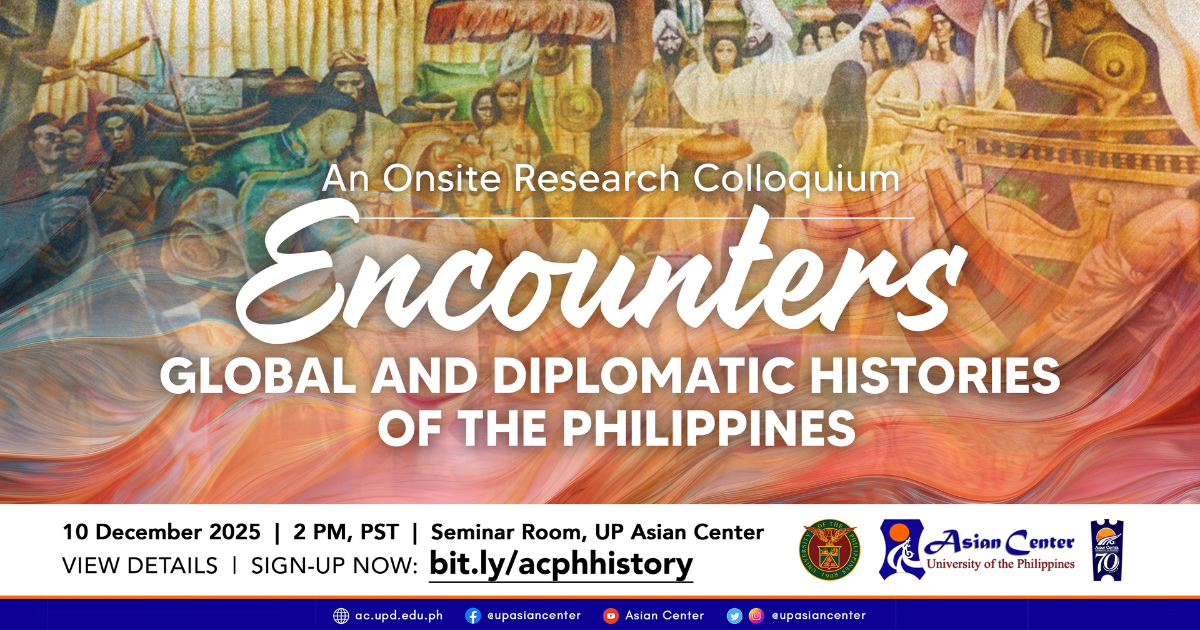
The UP Asian Center will be holding the onsite research colloquium "Encounters: Global and Diplomatic Histories of the Philippines" on 10 December 2025, 2:00 PM, PST (GMT+8), at the Seminar Room, UP Asian Center, University of the Philippines Diliman. The event is free and open to the public. Snacks will be served. Online pre-registration is recommended due to limited seating.
ABOUT THE COLLOQUIUM
Sources on Philippine history have always been from the primary sources created by colonizers. Recent scholarship has sought to create a history written through the use of sources from indigenous voices. Keynote speaker Dr. Tremml-Werner presents a conceptual framework where indigenous agencies take center stage in diplomacy and negotiations. The ideas from this keynote is expounded into two panels: Philippine Diplomatic History and the Philippines in Southeast Asia. The first panel is composed of students from PS 230 - History and Development of Philippine Foreign Relations who will present five research papers that tackle Philippine diplomacy, and how putting the indigenous voice at the center stage create mediums for conversations that forge long-lasting connections. The second panel is composed of four presenters from AS 252 - Independent Study on Southeast Asia, they will present the connections between the Philippines and Southeast Asia by highlighting Philippine sources to examine the different manifestations of conversations that were forged by these connections. The research colloquium seeks to contribute to the discourse of creating a history from Filipino voices and agency, reflecting on the conversations and connections that have been opened and remain to be unopened.
ABOUT THE KEYNOTE SPEAKER
A New Conceptual History of Early Modern Diplomatic Relations: Examples from the Philippines
The historical experience of maritime Southeast Asia, with its multitude of actors, forms of sovereignty, and systems of negotiations affected by colonialism and foreign impact, provides the ideal ground for researching and writing the history of inter-polity relations in the early modern world, here broadly defined as the period between the fifteenth and nineteenth centuries. Whilst most existing accounts of diplomatic history privilege actors, concepts, and developments originating from Europe, my talk will showcase new research that reconceptualizes early modern diplomacy as a global phenomenon ripe with local and indigenous agency. Introducing empirical examples from a variety of locations, I will discuss four scenarios (Manila, Pampanga, Sulu-Mindanao and Batanes) that allow us novel conceptual frameworks stressing negotiation and diplomacy over conventional, one-sided narratives of colonial encounter that overstate the dominance of the colonizer and obscure the agency of local actors.
BIRGIT TREMML-WERNER
Senior Lecturer, Stockholm University
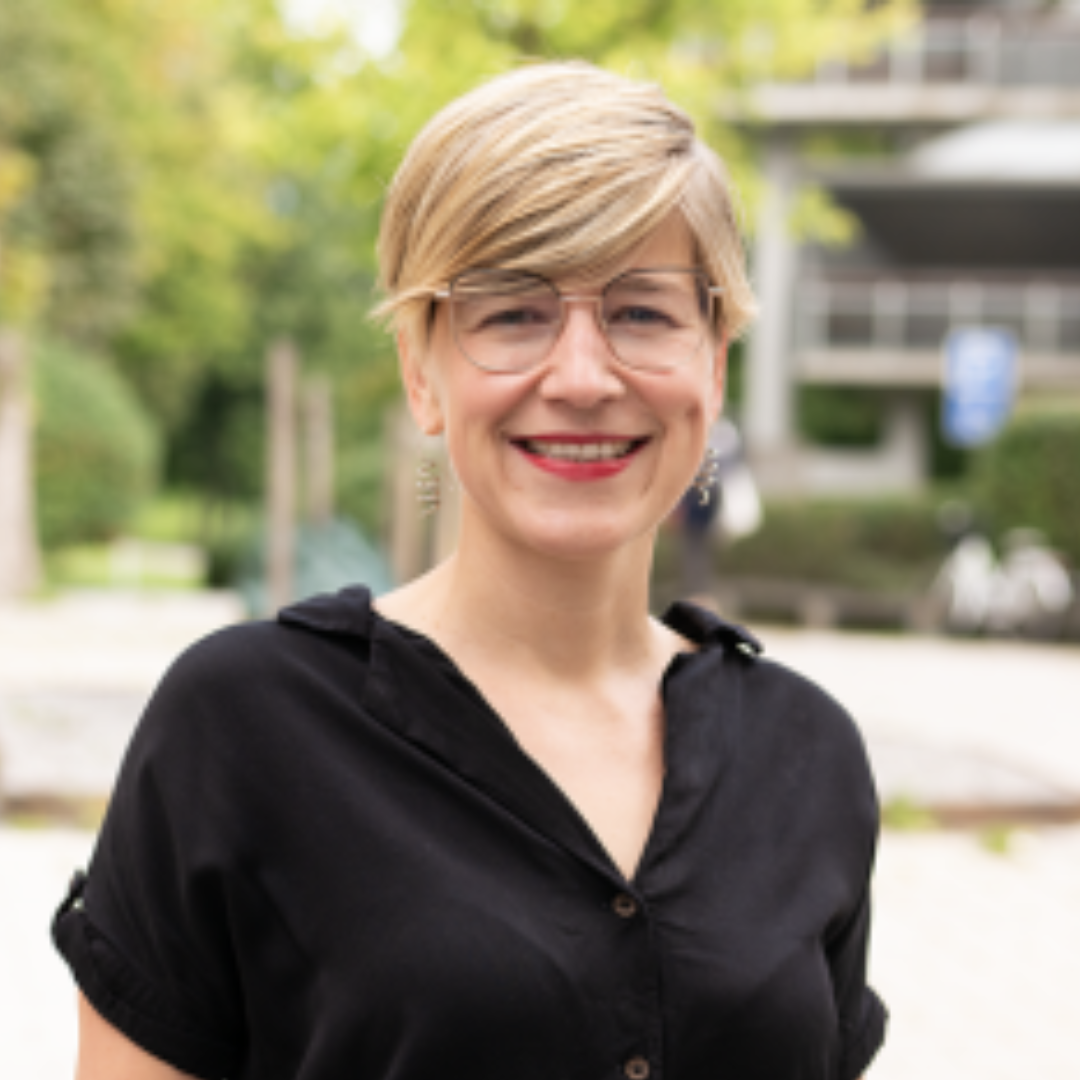
Birgit Tremml-Werner is an Adjunct Professor of the Asian Center, Univesity of the Philippines Diliman and a senior lecturer at Stockholm University in Sweden. She has a Mag. phil. and Dr. phil. degrees in History (with a minor in Japanese Studies) from the University of Vienna. She is the author of Spain, China, and Japan in Manila, 1571-1644: Local Comparisons, Global Connections (2015). See full profile.
ABOUT THE RESEARCH PRESENTATIONS
-
Women of the Philippines: Femininity and Diplomacy in Clemencia Lopez’s Speech in 1902, Massachusetts, USA
ANDREA ROCELLE A. BALINGIT
Student, Master in Philippine Studies, UP Asian CenterWomen have occupied less pages in history, even with the recent efforts to emphasize their voices. Even more so in Philippine diplomatic history considering diplomacy has always been a field dominated by men. However, this study argues that women took part and challenged the dominant practices in Philippine diplomatic history with their femininity by examining the speech of Clemencia Lopez at the Massachusetts Woman Suffrage Association in 1902. The study will utilize constructivist feminism theory and hermeneutic analysis to examine the speech, exploring how Lopez navigated the male-dominant field of diplomacy. The speech will be supplemented with American newspapers about Lopez’s visit, and letters sent to her to contextualize the speech and understand how Lopez used her femininity to her advantage, becoming the perfect representative of the Philippines during that time.
The Philippines is No American Lackey: Demonstrating Strategic Agency in the Vietnam War
NIKOLI GUILLAR
Student, MA in Philippines Studies, UP Asian CenterThe Philippines is widely seen as an American satellite state after gaining independence in 1946 and have become economically and politically dependent on its former master particularly in its foreign policy preference. However, the historical relationship between the Philippines and Vietnam during the Vietnam War reveals that Manila exercised agency and upheld its sovereignty even within the bipolar order of the Cold War. This paper examines the strategic role of the Philippines in the Vietnam War and challenges the prevailing narrative that the country merely acted as an extension of U.S. interests. Focusing on the administrations of Diosdado Macapagal and Ferdinand Marcos Sr., the study highlights how presidential leadership shaped foreign policy choices that navigated and balanced the competing interests of the era’s two superpowers.
Extra-Curricular Diplomacy: History of Model United Nations in the Universities of the National Capital Region (NCR) Philippines
ELAN KARSTEN CASTAÑARES
News Editor, KVH Media Group PhilippinesThis essay examines the history and development of Model United Nations (Model UN) with universities in the National Capital Region (NCR) of the Philippines, addressing the absence of local scholarly literature on the topic. While existing research highlights Model UN as an effective experimental tool for cultivating diplomatic literacy, negotiation skills, and engagement with the global community, little is known about its emergence and evolution in the Philippine context. Using a qualitative historical research approach, the study draws on primary sources including documents, conference records, and structured and semi-structured interviews with incumbent members of organizations from major NCR institutions. Through thematic analysis and chronological mapping, the essay reconstructs the trajectory of Model UN from early student-led initiatives to institutionalization across universities. The research essay also identifies unique local adaptation of international Model UN procedures and evaluates the activity’s perceived effectiveness on students’ diplomatic competencies and understanding of international affairs. Findings contribute the first comprehensive historical account of NCR-based Model UN and underscore its significance as an extra-curricular platform for fostering youth engagement in international affairs.
The Kuwait Disputes: Situating Philippine Labor Migration and the Rise of Welfare Diplomacy
FEDERICO “RED” RIOSA LACISTE IV
Labor and Employment Officer, Department of Migrant Workers (DMW)The Kuwait-Philippines series of labor and domestic worker protection disputes defined labor migration as a central arena for the interest of Philippine foreign policy. With an international relations lens, this paper will argue that repeated welfare crises involving Filipino domestic workers transformed Kuwait into a labor deployment site where the Philippines has employed coercive and normative diplomatic strategies such as deployment bans, ambassadorial recalls, and rights-based negotiation to reshape the behavior of migrant labor-hosting states. The paper’s discussion will emphasize how the 2018 Kuwait-Philippines bilateral labor agreement demonstrated the capability of a migrant worker sending-state such as the Philippines to leverage its labor supply to influence governance practices. Meanwhile, Kuwait’s 2023 visa restrictions highlight the constraints of Philippine bargaining power within the Middle East’s kafala system. By situating these episodes within the broader evolution of the labor attaché system and the rise of welfare-oriented diplomacy, the paper shows that labor migration is no longer peripheral to Philippine IR, but a key driver of its diplomatic posture in the Middle East.
From Informal Spaces to Formal Agreements: The Roles of Informal Diplomacy in Forging ASEAN
PHILIP CEASAR VILLAFLOR
Student, Master in Philippine Studies, UP Asian CenterThis paper reinterprets the role of the founding of the Association of Southeast Asian Nations (ASEAN) in 1967 in shaping and giving meaning to the development of cultural diplomacy. While one may argue that cultural diplomacy is a multifaceted concept, often understood through informal, personal, and even recreational means and exchanges, little is known about how historical narratives and meaningful personal exchanges have shaped the conceptual definitions, particularly the formative role, of informal diplomacy in early regional cooperation. This is not to mention that ASEAN’s founding is characteristically examined through traditional theoretical lenses, whether geopolitical, strategic, or economic. It is, therefore, the aim of this paper to explore and foreground the softer, arguably often overlooked, practices of diplomacy that shaped the early environment of trust and cooperation among regional leaders. Drawing on narrative analysis of personal accounts, memoirs, and secondary literature, this paper will highlight how recreational spaces, particularly golf courses in several countries, including Thailand and Malaysia, served not only for leisure purposes but also primarily for diplomatic agendas, where officials from the Philippines, Thailand, Malaysia, Indonesia, and Singapore engaged in relationship-building outside formal plenary discussions and negotiations. This paper argues that through these spaces, regional leaders are able to share aspirations with greater purpose, deepening their interactions beyond formal diplomatic settings. The conversations surrounding regional conflicts may have been one of the many topics discussed. Additionally, in this paper, informal diplomacy will be treated as a mode or practice, while cultural diplomacy will serve as the framework that explains how these practices convey mutual understanding. Situating golf and other social practices as forms of cultural diplomacy allows the researcher to argue that ASEAN’s founding was not solely a product of formal statecraft but also of cultural familiarity, social bonding, and personal trust established among leaders. Understanding this soft-power foundation offers invaluable insights into contemporary yet traditionally defined ASEAN diplomacy.
-
Integration or Rejection?: The Philippine Response to the Vietnamese Refugee Situation after the End of the Comprehensive Plan of Action (1996-2004)
NICOLE MARGARET A. VILLABROZA
Department of History, UP DilimanThe Comprehensive Plan of Action (CPA) for Indochinese refugees concluded in 1996, marking the “end” to the Vietnamese boat people saga. The Philippine government inherited the responsibility for managing the Vietnamese refugee situation, as the UNHCR transferred this duty to host countries in Southeast Asia. This shift presented significant challenges for both the refugees and the Philippine state. This paper explores the Philippine government’s post-CPA response, examining the challenges faced by Vietnamese refugees and the shortcomings of its government policies in achieving long-term social integration. The unresolved and undefined legal status of Vietnamese "long-stayers" left many without clear pathways to citizenship or permanent residency, resulting in uncertainty and limited access to employment and social services. Through an analysis of Philippine state policies, United Nations documents relating to the Refugee Convention and the CPA, and newspaper coverage, this paper demonstrated that despite the Philippines' reputation for its compassionate and humanitarian response to the Vietnamese refugee crisis, the failure to materialize meaningful integration policies exposed gaps in the government’s capacity to resolve this refugee situation in the country. Ultimately, the paper highlights the challenges of post-refugee crisis governance and the failure to establish sustainable solutions for long-term Vietnamese refugees in the Philippines.
Fluid seas, stable fields: Divergent moral economies in pre-colonial Visayas and South Sulawesi
KRISTINE S. CALLEJA
Social Entrepreneur and Co-founder, Advocates for Green Industries and Living EcosystemsThe pre-colonial societies of the Visayas and South Sulawesi share common Austronesian roots with minimal Indic influence. However, despite these shared features, they developed distinct moral economies—the implicit social contracts and mutual obligations between rulers and ruled—prior to Islamization and European colonization. This study compares the moral economies of the 16th-century Visayan barangay as described by William Henry Scott, and the South Sulawesi kingdoms as described by Stephen C. Druce. A comparative historical analysis was conducted using Scott’s Barangay (1994) and Druce’s The Decentralized Austronesian Polity (2017). The study utilized James C. Scott’s theoretical framework of moral economy to analyze leadership legitimation, resource distribution, and social stability. The analysis reveals that the Visayan moral economy was fluid and personal, based on achieved status (men of prowess), debt of gratitude (utang na loob), and maritime raiding. In contrast, the South Sulawesi moral economy was stable and institutional, based on ascribed status (white blood), binding treaties, and wet-rice agriculture. The study concludes that while both societies valued reciprocity, the South Sulawesi model evolved into a more rigid, contract-based system due to the demands of agrarian stability, whereas the Visayan model remained a flexible, meritocratic network suited for maritime mobility.
Centering the Middle-Class in the Philippine Government’s Upper-Middle Income Country (UMIC) Status Aspirations
DAYANARA LAUSA
Senior Economic Development Specialist, Department of Economy, Planning, and Development (DEPDev)The Philippines is on a trajectory of becoming an Upper Middle-Income Country (UMIC) having surpassed the target range of US$4,130 to US$4,203 gross national income (GNI) per capita set in the Philippine Development Plan 2023-2028. However, the paper argues that while attaining UMIC is inevitable given the country’s fast economic growth, remaining as one is uncertain due to the inherent vulnerability of the middle class brought by the government’s lack of support for their social welfare protection and a public investment that is heavily skewed toward hard infrastructure eroded by corruption and implementation delays. Through literature review of UMIC transitions Malaysia, Indonesia, and Thailand and participant observation from the Philippine Development Forum, this paper advocates for the middle class by challenging the prevailing paradigm of assessing economic success which prioritizes achievement of a certain level of GNI per capita, discusses about financing mechanisms alternative to official development assistance (ODA to mitigate the tax burden on the middle class, encourages policymakers to balance investments between hard infrastructure and soft infrastructure, and proposes a growth strategy that prioritizes social protection alongside infrastructure development.
The Role of the Pandita Estate in Knowledge Production in Premodern Muslim Mindanao and Sulu
JASON CRISTOBAL
Asian Center, UP DilimanThis paper examines the emergence of the Pandita Estate in the premodern Muslim society of Mindanao and Sulu. Derived from Mahmood Kooria’s conception of a Fuqaha Estate, this paper deconstructs the Pandita Estate to determine the internal power dynamics that influenced the production of orthodox and indigenous Islamic knowledge, the latter known as Ilmu Kamaasan in the Sulu archipelago and Ilmu sa Matoah/Minatoah in Mainland Mindanao, which both mean the knowledge of the elders. This deconstruction reveals that the Pandita Estate enjoys three distinct privileges: authority over performing rituals, the interpretation of nature and the divine, and judicial authority. These privileges enable the Pandita Estate to exert significant influence in society. Furthermore, a hierarchy is also observed among members of the Pandita Estate, which depends on the Pandita’s scholarly background, including the location and scope of their education, as well as the scholars from whom they received knowledge. The paper highlights how Panditas who ventured to established Islamic centers of learning, such as Aceh and Banten in maritime Southeast Asia and the Hejaz in the Arabian peninsula, for their Islamic education produced works of mainstream Orthodox Islamic scholarship. At the same time, the cost-prohibitive nature of foreign study during the premodern era created a second class of Panditas educated locally or in nearby polities in Borneo. These locally educated Panditas produced works that form part of the local knowledge tradition, integrating significant indigenous elements that lead to the formation of syncretic Islamic practices in the region.