

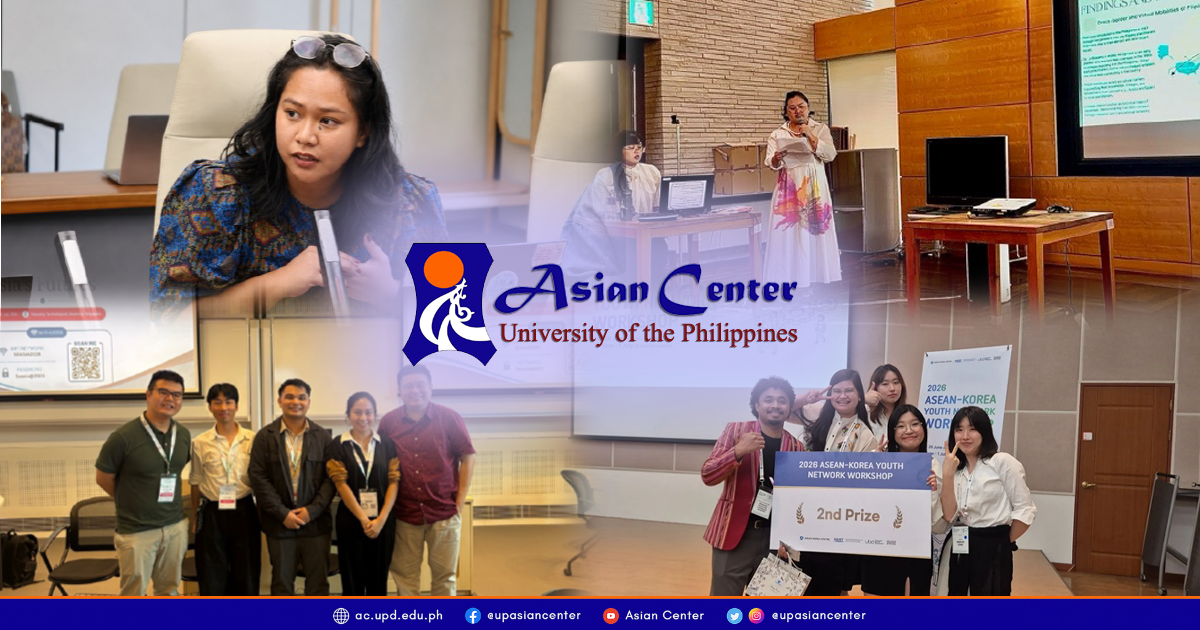
UP Asian Center Students continue to make their mark in the academic scene as they presented their research at various national and international conferences during the first half of 2026 (January to July 2026). Students from both AC Philippine and Asian Studies Programs brought their fresh perspectives to a diverse range of discussions, demonstrating the breadth of their scholarship and their engagement with pressing social, cultural, and regional issues.
AC Student Sarah Vernice Sison of the MA Philippine Studies Program, major in Philippine Development Studies, presented her paper, "Who Speaks for Development? An Inquiry into Philippine Development Studies," at the Second Biennial Conference of Pluriversalism and the Global South on 9 -10 May 2026 at Tongji University in Shanghai.
Her presentation examined the landscape of development discourse in the Philippines through a critical analysis of development policy and academic scholarship, suggesting that it remains deeply embedded in Western developmental paradigms. As a result, prevailing conceptions of development tend to narrow the political and conceptual horizons of nation-building, limiting space for alternative visions rooted in locally grounded and non-Western epistemologies. Sison calls for the cultivation of counternarratives capable of expanding and reimagining development in the Philippine context. The Conference theme is guided by the concept of pluriversality, a theory of decoloniality that challenges dominant narratives and recognizes the human power to build worlds differently and envision different models for inhabiting the planet” (Leitão 2023). It was organized by the Global South Research Center of Tongji University.
Promoting Japanese Studies, Asian Studies Student Ma. Kamille Untalan specializing in Northeast-Asia Japan presented at the Workshop and International Symposium, Global Mobilities and Flows of Soft Power: Tourism, Culture, and International Relations, organized by the College of Tourism of Rikkyo University, and the Asia-Europe Institute (AEI) of Universiti Malaya, Sunway University, Malaysia and supported by the Japan Association for Malaysian Studies. The event was held on 1 and 2 July 2026 at the Niiza Campus of Rikkyo University, Japan. Untalan presented her paper, “Healing Across Borders: An Ethnographic Study of the Transmigration and Adaptation of Reiki in The Philippines” which was based on her master’s thesis. She has graduated with a degree in MA Asian Studies (Northeast Asia - Japan) on 5 July 2026. Her research interests include complementary healing modalties, women and gender, and transnational cultural exchange.
One of the few West Asia Majors of the Asian Center, Rebecca Verzola presented her research, "Water Governance in the Jordan River Basin: Climate Pressures, Political Conflicts, and Cooperative Solutions," in Norway at the Early-Career Researchers Workshop on 23 June 2026 and the International Association for Water Law World Water Congress 2026 on 24-26 June 2026.
The workshop was organized by the Geneva Water Hub especially designed for early career researchers and scholars to train the next generation of water law, policy, and hydro-diplomacy experts. Meanwhile, the AIDA World Water Congress was hosted by the University of Oslo (UiO), the Norwegian University of Life Sciences (NMBU) and the Norwegian Institute of Water Research (NIVA). With the theme, Water Law and Governance in Times of Climate Change and Biodiversity Loss, the congress provided a platform for participants from diverse backgrounds, professions, and discipline to discuss water law, governance, and policy.
In her presentation, Ms. Verzola argued that in order to promote governance in transboundary water basins such as the case of the Jordan River Basin (JRB), sustainable water governance in the JRB requires a comprehensive basin-wide agreement that integrates law, policy, technological innovation, and community participation. Shared by Jordan, Israel, Syria, Lebanon, and Palestine, this body of water had been the subject of long hydro politics resulting to power asymmetry among the states, marginalization of local communities and severe resource scarcity. The study revealed that fragmented and outdated treaties that aim to address the issue neglected other factors as groundwater and ecological sustainability, and issues in governance including lack of transparency, accountability, and adaptability.
Students of Philippine Studies – Socio-Cultural Studies specialization also presented their research at international conferences. Jericho Daniel Igdanes, MA Philippine Studies shared his research on family history and genealogy research at the 6th SEASIA Biennial Conference of the Consortium of Consortium for Southeast Asian Studies in Asia with theme “Forging Southeast Asia’s Futures: The 6th Southeast Asian Studies in Asia Biennial Conference.” His paper was entitled “Filipino family genealogy research practices as contact zones and dialogical spaces.” Igdanes interrogated the emerging interest in family history research in the Philippines, its practice and methods. His findings revealed that family history research practices in the Philippines occur in various forms, such as visits to physical archives, collection of oral accounts, and the use of digital tools.
The study affirmed that Filipino family history research is both intercultural and dialogical. Moving beyond mere recovery of information about one’s ancestors, it also serves to reorient one’s concepts of identity and belongingness.
The SEASIA Biennial Conference is the principal gathering of the Consortium for Southeast Asian Studies in Asia (SEASIA), a region-based academic network connecting leading universities and research institutions across Asia where the UP Asian Center is a member. The sixth iteration of the conference was held on 8 to 10 July 2026 at the Nanyang Technological University, Singapore.
Meanwhile, Korea Majors of the UP Asian Center continue to demonstrate their research and presentation skills as they once again participate in international gatherings. Chynna Riego of the Master in Asian Studies Program specializing in Northeast Asia-Korea represented the Asian Center and the UP Korea Researcher Center along with other students from UP Diliman in the 2026 ASEAN Korea Youth Network Workshop from 24 to 26 June 2026 in Daejeon, South Korea, and from 26 June to 1 July 2026 in Bandar Seri Begawan, Brunei.
Ms. Riego’s group won two main activities in the workshop namely the Youth Action Video Campaign, where they won Second Place, and the Policy Proposal Presentation, where they won First Prize. Their presentation, entitled, “Project MAEUM: Mobilizing ASEAN- AI Empowerment through Upskilling and Mentorship,” proposes opening workforce pathways to the economically challenged, persons with disabilities (PWDs), and neurodivergent youth through AI education, workforce upskilling, and mentorship. This policy aims to create Localized AI Hubs within the region to promote the building of a region-specific AI model (Riego and Bersamira n.d.).
Only 20 students from all over ASEAN and South Korea were selected to participate. Guided by the theme, Empowering ASEAN-Korea Youth: Digital Innovation for Inclusive Development, the workshop sought to harness the power of AI and digital technologies towards the promotion of ASEAN-Korea relations, digital innovation, and inclusive development. The workshop was organized by the ASEAN-Korea Centre, in partnership with Korea Advanced Institute of Science and Technology (KAIST) and Universiti Brunei Darussalam (UBD).
Through the active participation of its students in academic conferences and scholarly events, the UP Asian Center continues to advance the University of the Philippines’ tradition of academic excellence, public service, and knowledge production. The research and presentations of AC students demonstrate their engagement with diverse issues and perspectives across the Philippines and Asia, contributing to a deeper understanding of the region and its interconnected societies. Together with its faculty and staff, the UP Asian Center remains committed to nurturing the next generation of scholars and advancing Philippine and Asian Studies through rigorous research, meaningful academic exchange, and the wider dissemination of knowledge.
References and Sources:
-
- Leitão, Renata M. 2023. “Pluriversal Worlding: Design, Narratives, and Metaphors for Societal Transformation.” AM Journal of Art and Media Studies 30: 17-35. https://doi.org/10.25038/am.v0i29.551.
- Riego, Chynna Louise and Jan Miguel Bersamira. n.d. "Representing UP at the 2026 ASEAN-Korea Youth Network Workshop." UP Korea Research Center. Retrieved 17 September 2026. https://upkrc.wordpress.com/2026/07/20/representing-up-at-the-2026-asean-korea-youth-network-workshop/?utm.
- Photos Provided by Sarah Vernice Sison, Jericho Daniel Igdanes, and Rebecca Verzola. Photos of Chynna Riego taken from Riego, Chynna Louise and Jan Miguel Bersamira. n.d. "Representing UP at the 2026 ASEAN-Korea Youth Network Workshop." UP Korea Research Center. Retrieved 17 September 2026. https://upkrc.wordpress.com/2026/07/20/representing-up-at-the-2026-asean-korea-youth-network-workshop/?utm.