

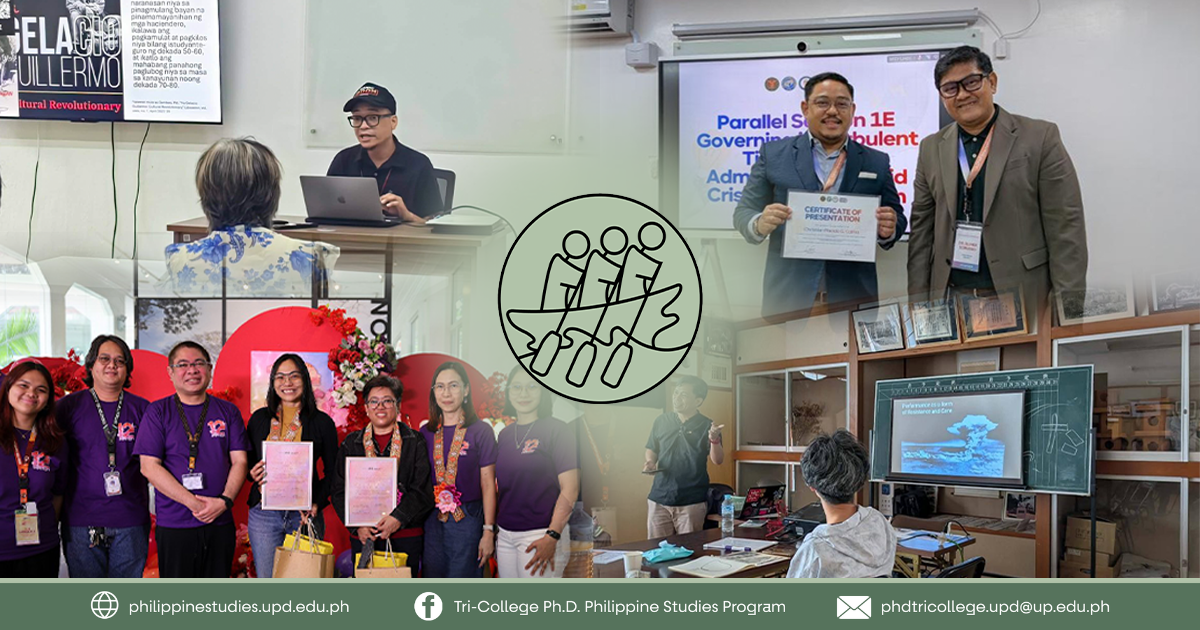
TriCollege Ph.D. Philippine Studies Program Students showcased their research and presentation skills as they participated in local, national, and international academic conferences for the first half of 2026. Many students participated in local conferences organized by various institutions in the Philippines and abroad.
Jomar Gonzales Andaya presented “Si Gelacio Guillermo at ang Rebolusyonaryong Dagli” at the Tatsulok: Pambansang Kumperensiya sa Philippine Studies organized by the UP Diliman Department of Filipino and Philippine Literature and the UPD-Office for Initiatives in Culture and the Arts (OICA). The conference was held last 18 to 19 June 2026 at the IBG KAL Theater and Palma Hall in UP Diliman. In his presentation, Andaya assessed and critiqued the work of Gelacio Guillermo who employed the literary form dagli in his works, particularly its role within revolutionary literature during the 1970s and the 1980s. Guillermo was a Filipino poet and writer who was known activist and revolutionary during this period. Andaya argued that Guillermo’s use of dagli demonstrates how this literary form can serve as an expression of revolutionary practice, offering a counter-narrative to dominant histories and a means of social and literary critique.
Similarly, Christian Placido G. Calma also shared his research findings at a national conference held in UP Diliman. He examined the transition of the Public-Private Partnership (PPP) Center of the Philippines from face-to-face training to Online Capacity Building Activities (OCBA) during the Covid-19 pandemic, through his paper, “Governance Under Pressure: Kapwa-Mediated Change and Digital Capacity Building in a Philippine Government Agency.” Calma analyzed how organizational change within PPP was enabled not only through technical adjustments but also through relational dynamics. During a crisis where resources are constrained, he argued that kapwa is not a cultural gloss on organizational change theory but the operative mechanism through which change was achieved.
The 2027 Association of Schools of Public Administration in the Philippines (ASPAP) Conference was organized in conjunction with the Pahayag Masterclass Seminar Series on the Latest Methods and Trends in Public Administration Education and Research. It was held on 9 June 2026 at the National College of Public Administration and Governance (NCPAG), UP Diliman, organized by the Association of Schools of Public Administration in the Philippines (ASPAP).
TriCollege students were also invited as resource speakers in national conferences. Bernadette V. Neri presented at the 12th Area Studies National Conference with the theme “IMAHEN: Reimagining Women and Gender Representations in Philippine Popular Culture.” She located the experiences of female homosexuals within the national memory, noting that LGBTQIA++ experiences remain invisible in Philippine history and law. She argued, “Kailangan igiit na hindi magiging ganap ang kasaysayan ng kasaysayan ng kababaihan at ang mismong kasaysayan ng Philippines hangga’t hindi nito nailulugar ang mga babaeng homosekswal” (Aguhon Online 2026). Her paper was entitled, "NARATIBÔNG HISTORIKAL: Kritikal na Pabulasyon bilang Metodo ng Reinterpretasyon at Rekonstruksiyon ng Lesbiyanang Danas at Imahen." The conference was held on 26 to 27 March 2026 at the UP Manila Museum of a History of Ideas.
Going beyond local and national gatherings, Tri-College students also actively shared their research in international conferences held in the Philippines and abroad.
From 28 to 30 May 2026, Nell B. Buenventura served as one of the presenters at the 9th International Conference on Asian and Philippine Studies organized by the De La Salle University and held in Cagayan de Oro City. Nell presented his research, “Introduksiyon sa Lingguwistikang Pandispleysment (LpD) sa Diskursong Panrelokasyon,” proposing Displacement Linguistics as a framework for examining dynamics of language and linguistics discourses in the context of resettlement and relocation within the broader of issue of urbanization in the Philippines. Through examining the relationship among linguistic practices, spatial restructuring, and identity formation in communities affected by relocation policies, the study highlighted the importance of language in understanding the complex experiences of internal migration and urbanization in the Philippines, particularly the processes of displacement resulting from coerced human mobility and counter-displacement through the reconstruction of identity.
Likewise, Arman D. Mangilinan also presented at the same conference in Cagayan de Oro with Nell. His research focused on the creative industry particularly the experiences and conditions of artists and cultural workers in Malabon using the framework of lúsong/palúsong and súlong/pasúlong. Through an examination of language, history and experiences of performance groups in city, he argued that the informality of the creative industry reflects a deeply embedded social reality that should be recognized as a foundation for the development of just and inclusive cultural policies. Entitled, “Palúsong-Pasúlong: Dalumat sa Kalagayang Impormalidad ng mga Artista’t Manggagawang Pangkultura sa Bayan ng Malabon,” Arman’s paper proposes the use of súlong/pasúlong as a development concept that seeks to to shift the cultural sector from conditions of informatlity toward greater recognition, protection, and dignity through communal, national, and regional support.
TriCollege students also represented the TriCollege Program in academic events abroad. Leomar P. Requejo and Leonardo R. Dela Cruz participated in separate international conferences in Japan; Requejo at The Asian Conference on Cultural Studies (ACCS2026) on 9 to 13 May 2026 at the Tokyo International Forum organized by the International Academic Forum while Dela Cruz presented at the Go Beyond Empty 2026 International Performance and Conference on 3 to 6 May 2026 at the Tomi-Shi, Nagano City Japan. Leomar presented his paper, “Cinematic Catastrophes: Disaster Aesthetics in Philippine Films” where he investigated how selected Filipino films construct distinct “disaster aesthetics” that articulate the nation’s encounters with calamity, trauma, and collective recovery.
He argues that Philippine disaster aesthetics do not merely replicate global tropes; instead, they localize and transform them through hybrid forms—such as docu-fiction, slow cinema, horror-inflected realism, and surrealist symbolism—that mirror the country’s social and cultural landscapes. Meanwhile, Leonardo examined "Pakialam" as a Filipino concept of care and used it as a theoretical framework for the practice of performance art in the Philippines through his paper "Performance as Care and Resistance." His discussion focused on the relationship between performance art, memory, and history using his own performance art that interpreted the Philippine-American War of 1898-1916, Martial Law of former President Marcos Sr. (1972-1986) and Extrajudicial Killings during the era of Presidents Gloria Macapagal Aroyo and Rodrigo Duterte.
Through their participation in conferences in the Philippines and abroad, Tri-College Students demonstrate the breadth and relevance Philippine Studies research across disciplines, communities, and geographic contexts. From language and migration to cultural work, film, and performance art, their studies engage with pressing social and cultural issues in the country while contributing to broader international academic conversations. The students active participation reflect the Tri-College Program’s commitment to developing scholars who can situate Philippine experiences within wider regional and global discourses, while bringing locally grounded perspectives to international spaces.
References and Sources:
-
- Aguhon Online. 2026. “The 12th Area Studies National Conference with the Theme of ‘IMAHEN: Reimagining Women and Gender Representations in Philippine Popular Culture.’” Facebook, April 16, 2026. https://www.facebook.com/AguhonOnline/posts/1655649339261353/?utm.
- Photos Provided by Jomar Andaya, Christian Calma, Leonardo Dela Cruz, Bernadette Neri, and Leomar Requejo. Photos of Bernadette Neri were taken by the Information, Publication, and Public Affairs Office of the University of the Philippines Manila.