

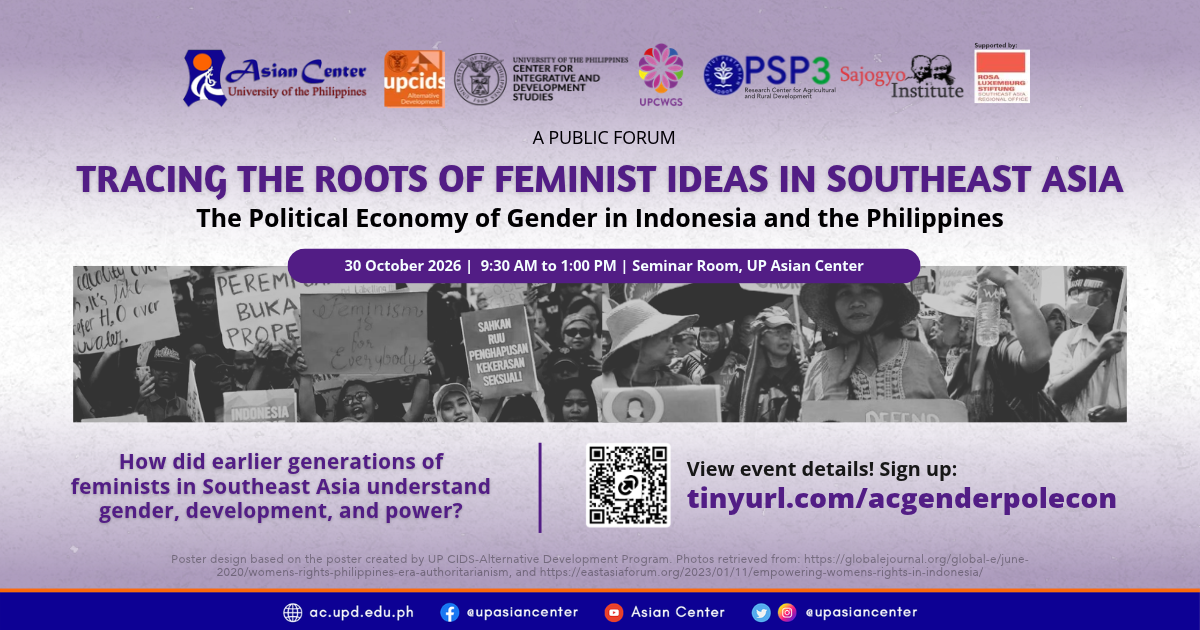
The UP Asian Center, together with its partners, will conduct a public forum "Tracing the Roots of Feminist Ideas in Southeast Asia: The Political Economy of Gender in Indonesia and the Philippines," on 28 October 2026, 9:30 AM, PHT (GMT+8) to 12:00 PM, PHT at the Seminar Room, Asian Center, UP Diliman. The event is free and open to the public. Registration is encouraged due to limited seating.
ABOUT THE EVENT
Feminism has been theorized and understood through predominantly Western frameworks, obscuring the diverse ways feminist ideas and movements have emerged in other contexts. Feminist thought in Southeast Asia has been shaped by their local histories, anti-colonial struggles, and efforts to visibilize their precolonial cultural and religious systems – underscoring the need to surface the diverse and contextually grounded ways of understanding gender, power, and women’s struggles in the region. They also call for closer examination of the political economy of gender: how gender relations are shaped by, and in turn shape, economic structures, political institutions, and other systems of power within specific historical and sociopolitical contexts.
The feminist intellectual contributions of Pudjiwati Sajogyo in Indonesia and Elizabeth Uy Eviota in the Philippines offer important entry points for such conversations. Pudjiwati pioneered the study of women’s roles in agrarian change, rural communities, and development in Indonesia through action research. Her work, published during the authoritarian New Order regime (1965–1998), criticized the state’s perspective on women—as reflected in the 1974 Marriage Law and national statistical data (BPS)—which tended to reduce women to the status of passive, male and domestic dependents, and thus as individuals who made no contribution to rural development. Beside her academic works, she also played a pivotal role in institutionalizing gender studies, both nationally (by initiating the establishment of Women’s Studies Centers at universities across Indonesia) and internationally (serving as a member of the UN Committee on the Elimination of Discrimination against Women, or CEDAW, in 1988). To this day, her intellectual legacy—covering topics such as the allocation of time, decision-making processes, labour and land access, and the stratification of rural women—remains a foundational reference for contemporary scholars in the field of gender studies. Meanwhile, Eviota’s seminal work, The Political Economy of Gender, examined gender relations in the Philippines in relation to the country’s colonial history and its subordinate position within the international political economy. She further examined how the sexual division of labor is constituted and reproduced across diverse spheres of social life: the household and the state, town and countryside, and systems of property, exchange, trade, and technology.
Building on these discussions, the forum will bring Filipino and Indonesian scholars who worked on the political economy of gender into dialogue, wherein they can draw, or revisit on the landmark contributions such as those authored by Elizabeth Eviota in the Philippines and Pudjiwati Sajogyo in Indonesia. Through comparative dialogue, the forum aims to identify common threads, key differences, and the continuing relevance of these works to contemporary gender issues, feminist scholarship, and movements in both countries.
Session 1: Revisiting Pudjiwati Sajogyo’s Feminist Scholarship
Pudjiwati’s Works and Contributions
GANIES OKTAVIANA
Research Center for Agricultural and Rural Development (PSP3)
Institut Pertanian Bogor University, Indonesia
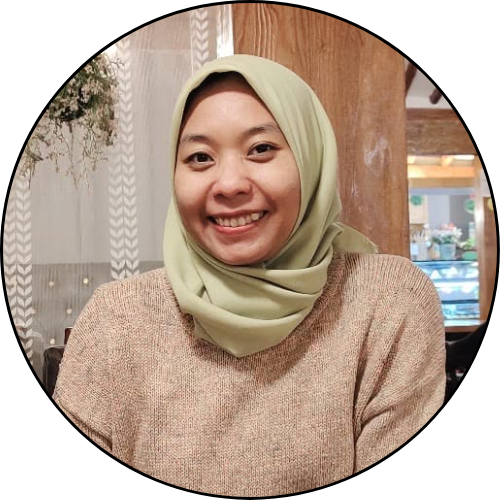
Ganies Octaviana is a researcher and community facilitator at PSP3. Her work focuses on issues concerning rural agrarian conflict, social reproduction, and labor. She is an active member of a labor union in Indonesia, SINDIKASI, and a feminist collective, Sawit Women Education Group (SWEG).
Reflections on Pudjiwati’s work and its relevance to contemporary issues
WIDA DHELWEIS YISTIARANI
Sajogyo Institute, Indonesia
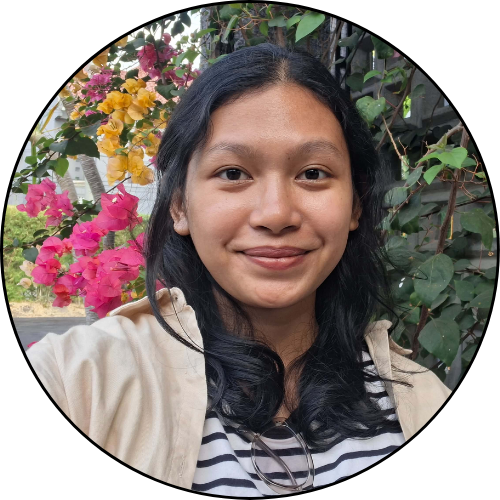
A researcher at the Sajogyo Institute. Her work centers on agrarian political economy, particularly how land relations, dispossession, and gender shape rural livelihoods amid infrastructure development and socio-ecological crises. She is the author of "Geger Gedhen di Pesisir Selatan Jawa: Pembangunan Bandara dan Dinamika Kelas Agraria di Yogyakarta (2024)" a book examining agrarian class relations and rural livelihoods in the context of airport development in Yogyakarta.
Session 2: The Political Economy of Gender in the Philippines
ELIZABETH UY-EVIOTA, Ph.D.
Faculty, Department of Sociology and Anthropology, Ateneo de Manila University
Associate, WomanHealth Philippines

Dr. Elizabeth Uy-Eviota is a faculty member in the Department of Sociology and Anthropology, and an associate at WomanHealth Philippines. Author of the groundbreaking book, ’The Political Economy of Gender: Women and the Sexual Division of Labour in the Philippines’ (1992). Her work centers on social inequality, gender issues, political economy, conflict, development, the state.
CAROLYN I. SOBRITCHEA, Ph.D.
Professorial Lecturer, Asian Center, University of the Philippines Diliman
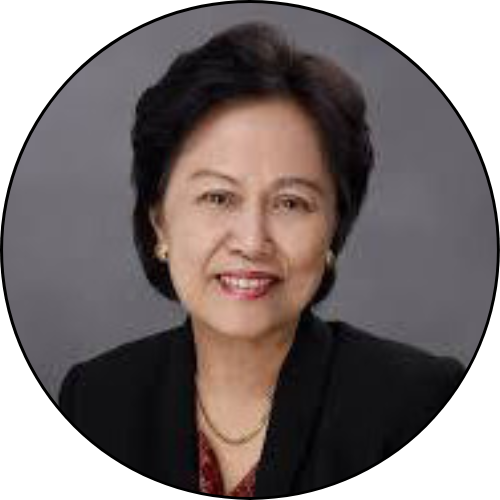
Dr. Carolyn Sobritchea is the former Director of the UP Center for Women’s Studies and Dean of the UP Asian Center. Currently serves as a Professorial Lecturer at the UP Asian Center. She authored ‘Gender Ideology and the Status of Women in a Philippine Rural Community’ (2004). She has led research, training, and policy initiatives on gender mainstreaming, migration, human rights, climate change, peacebuilding, and women’s empowerment.
ABOUT THE REACTORS
VERNA DINAH Q. VIAJAR, Ph.D.
Assistant Professor, UP School of Labor and Industrial Relations (SOLAIR)
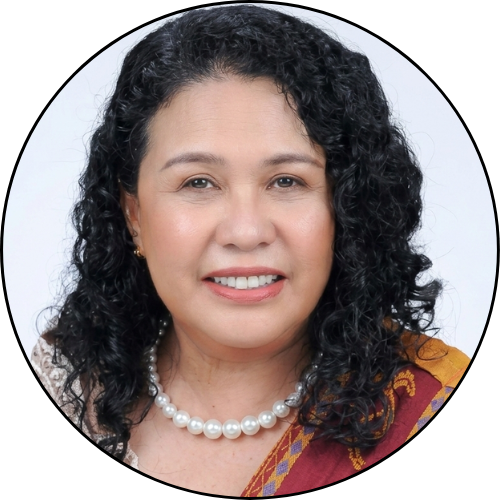
Dr. Verna Dinah Q. Viajar is an Assistant Professor and Graduate Studies Program Coordinator of the UP School of Labor and Industrial Relations (SOLAIR). The author of ‘Dimensions of Precarity: Spaces, Constraints and Tensions in Organizing Migrant Domestic Workers in Malaysia,’ (2023). Her research and academic interests include labour and migration studies, political economy, democratization and Southeast Asia politics and government.
MARIA DULCE F. NATIVIDAD, Ph.D.
Professor, Asian Center, University of the Philippines Diliman
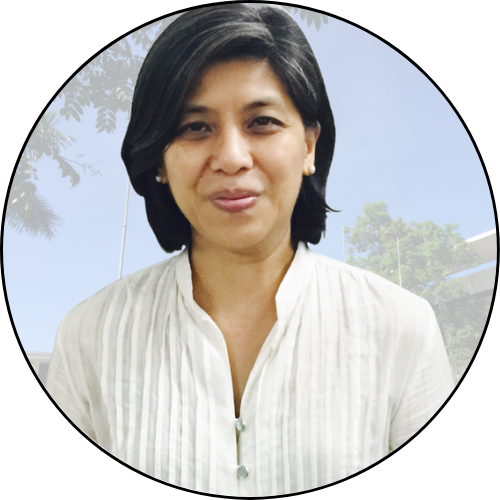
Dr. Maria Dulce F. Natividad is a Professor at the UP Asian Center and a Co-convenor of the Program on Alternative Development at UP CIDS. She is the author of ‘Catholicism and Everyday Morality: Filipino Women’s Narratives on Reproductive Health,’ (2018). Her work focuses on medical anthropology, globalization and the political economy of health, gender and sexuality, religion and secularism, and the history and anthropology of science and medicine.
ABOUT THE ORGANIZERS
This forum is organized by the UP Asian Center in partnership with the UP CIDS Program on Alternative Development, the UP Center for Gender and Women Studies, the Research Center for Agricultural and Rural Development (PSP3), and the Sajogyo Institute, supported by the Rosa Luxemburg Stiftung: Southeast Asia Regional Office.
For inquiries, please contact us at This email address is being protected from spambots. You need JavaScript enabled to view it. or call 891-8500 loc. 3586.