

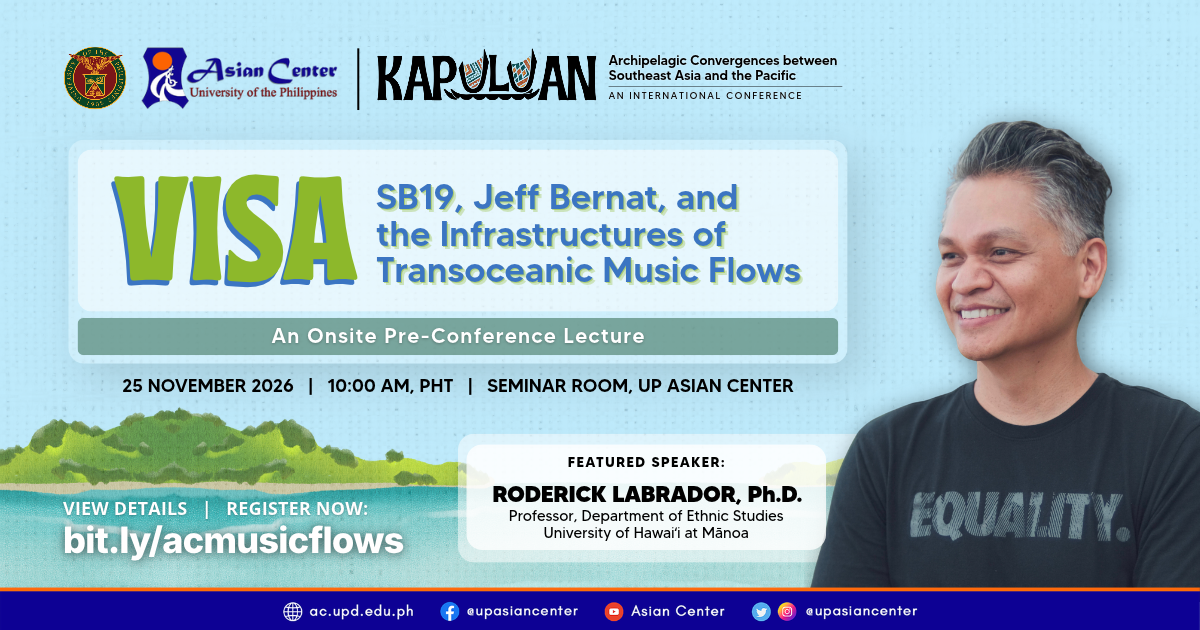
The UP Asian Center with the support of the UP Office of International Linkages will be hosting the pre-conference lecture "Visa: SB19, Jeff Bernat, and the Infrastructures of Transoceanic Music Flows" on 25 November 2026, 10:00 AM, PHT, at the Seminar Room, UP Asian Center. The event is free and open to the public. Online registration is required due to limited slots.
ABOUT THE FORUM
Recognition at home often has to be earned abroad. This paper examines that circuit through two artists, Filipino American singer-songwriter Jeff Bernat and the Philippine group SB19, asking who constructs and controls transoceanic music flows.
In 2014, Bernat contributed two songs to the soundtrack of the Korean drama Fated to Love You, leading to chart success and collaborations with artists like Dean, Crush, and Whee In. Neither Korean nor singing in Korean, he built a larger following in Korea, Japan, and Southeast Asia than in the United States. I argue that he circulates R&B much as Filipino and Filipino American musicians popularized jazz in early twentieth-century Japan (Atkins 2001), enabled by Korean cultural and media infrastructures, including K-R&B, K-Pop, and K-drama soundtracks, that have no equivalent for him in the United States.
SB19’s 2026 single “Visa,” whose title plays on international borders and recognition, confronts the circuit’s other side. Inspired by the group’s touring and the Philippine passport, it notes the irony of a people praised globally yet restricted by bureaucracies, and name-checks Filipino Americans like Dante Basco, Bruno Mars, and Olivia Rodrigo. It asks whether recognition depends on national reputation rather than talent, and why validation must come from abroad before broad respect at home. The paper argues that infrastructures carrying music across oceans are place-specific. Drawing on a Bernat interview, concert fieldwork, and media analysis, this talk illuminates Filipino mobility and belonging across Asia and the Pacific, where cultural connection and border crossing run side by side.
ABOUT THE SPEAKER
RODERICK LABRADOR, Ph.D.
Professor, University of Hawaiʻi at Mānoa
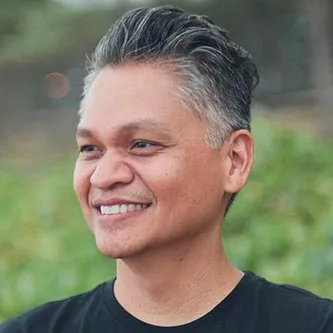
Roderick N. Labrador is a Professor in the Department of Ethnic Studies at the University of Hawaiʻi at Mānoa. He earned his PhD in Anthropology from the University of California, Los Angeles, and his MA in Asian Studies, specializing in Philippine Studies, from the University of Hawaiʻi at Mānoa. His research and community engagement focus on Filipino transnationalism, diaspora, race and ethnicity, migration, culture, language, education, and cultural production in Hawaiʻi, the United States, and the Philippines. He is the author of Building Filipino Hawaiʻi, which examines identity formation and the politics of representation among Filipino immigrant communities. His ongoing research also explores Filipino American cultural production and the intersections of identity, politics, and place through hip-hop. His work bridges academic scholarship and community engagement, particularly in advancing the understanding of Filipino diasporic experiences and cultural expressions.
ABOUT THE ORGANIZERS
This lecture is organized by the UP Asian Center with support from the UP Office of International Linkages (UP OIL). For inquiries, please contact us at This email address is being protected from spambots. You need JavaScript enabled to view it. or call 891-8500 local 3586.